
-
ProductsThe manufacturer provides supporting services and offers you a one-stop procurement platform for fire accessories and products

-
About usAn industrial and trade fire company integrating the development, production, sales, and service of fire accessories.
-
-
-
Contact us

_
30
2025
-
10
Rubber Fire Fighting Hose -An Effective Tool for Safety
Rubber fire fighting hoses stand as critical components in fire safety systems worldwide, widely used by fire departments, industrial facilities, and commercial buildings. Renowned for exceptional pressure resistance, weather durability, and flexible operation, these hoses are crafted from high-quality rubber materials paired with advanced reinforcement technologies. As long-lasting, high-performance fire suppression tools, they consistently meet stringent international safety standards, providing stable support across diverse global fire safety scenarios.
In fire suppression and rescue operations, the reliability of equipment directly impacts the efficiency of hazard control and the protection of lives and property. Among these essential tools, rubber fire fighting hoses serve as the core link between fire water sources and extinguishing endpoints—indispensable for fire safety professionals, whether they are municipal firefighters or in-house emergency response teams. Capable of adapting to diverse global fire safety needs, these hoses handle complex scenarios such as extreme weather and high-pressure operations with ease, acting as a vital backbone for effective fire-fighting efforts.
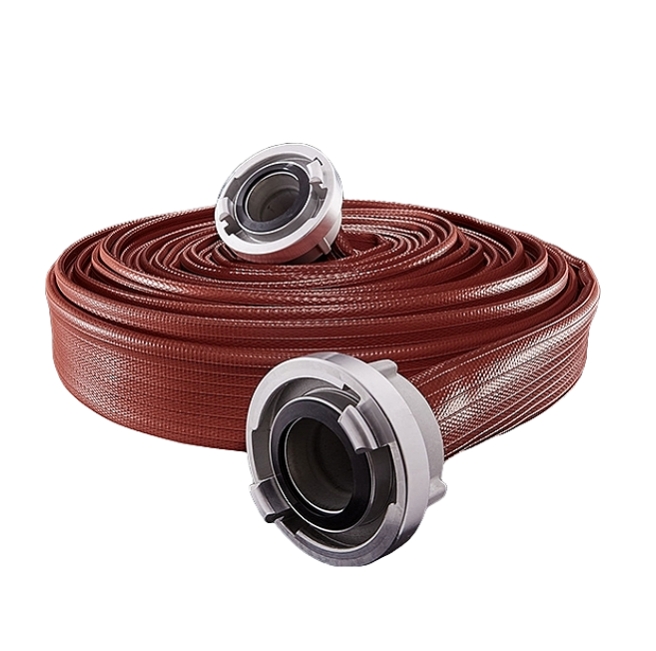
The core advantage of rubber fire fighting hoses lies in their long-term reliability, rooted in high-quality materials. Most hoses feature high-grade synthetic rubber for both inner and outer layers—material selected for its outstanding resistance to wear, tearing, and chemical corrosion. Unlike traditional PVC hoses, which tend to crack in low temperatures and degrade under prolonged UV exposure, rubber fire fighting hoses maintain stable performance even in extreme climatic conditions:
Wide Temperature Adaptability: Operate reliably within a temperature range of -30°C (-22°F) to 80°C (176°F), making them suitable for cold regions like Northern Europe and hot, arid areas such as the Middle East.
Strong Abrasion Resistance: The outer rubber layer is often reinforced with a woven polyester mesh, effectively withstanding scratches, impacts, and friction from rough surfaces (e.g., concrete, metal, rocky terrain) during emergency deployments, thus extending service life.
Excellent Chemical Resistance: Tolerate erosion from oil, fuel, and common industrial chemicals, ensuring compatibility with various fire-extinguishing agents and suitability for complex industrial settings like factories and refineries.
Fire safety operations demand exceptional pressure resistance from equipment—and rubber fire fighting hoses excel in this aspect. A standard rubber fire fighting hose typically boasts a working pressure of up to 200 PSI (13.8 bar) and a burst pressure exceeding 600 PSI (41.4 bar). Even during high-intensity fire-fighting tasks, these hoses guarantee a steady, powerful flow of water or fire retardants:
Multi-Layer Reinforced Structure: Most models incorporate a layer of high-tensile polyester yarn between the inner and outer rubber layers. This structural optimization enhances pressure resistance, effectively preventing leaks caused by kinking or pressure fluctuations that could disrupt fire-fighting progress.
- Smooth Inner Lining Technology: The inner rubber layer undergoes a super-smooth treatment process, minimizing water flow resistance to the greatest extent. This boosts water output per unit time, helping to quickly suppress fires and reduce the spread of flames.
- Diverse Specification Options: To meet different scenario requirements, rubber fire fighting hoses come in a wide range of specifications. Diameters include common sizes such as 1.5 inches, 2 inches, and 2.5 inches, while lengths vary from 25 feet to 100 feet. Whether for small commercial fires or large-scale industrial blazes, a suitable product can be found.
In fire emergency scenarios, every second counts for rescue effectiveness. Rubber fire fighting hoses are designed with practical convenience in mind, featuring user-friendly optimizations to simplify deployment and operation, and reduce the burden on operators:
- Lightweight and Flexible Traits: Despite their robust structure, modern rubber fire fighting hoses prioritize lightweight design in material proportioning. Compared to traditional heavy rubber hoses, products of the same size are approximately 30% lighter, facilitating easy carrying and rapid deployment. They can even be flexibly maneuvered in narrow spaces such as tight corridors, stairwells, or gaps between industrial equipment.
- Leak-Proof Fitting Configuration: Fittings are mostly made of heavy-duty brass (some models offer lightweight aluminum fitting options). Combined with precision thread processing technology, they ensure a secure connection to fire hydrants, water pumps, and nozzles, effectively preventing fitting leaks and guaranteeing stable water supply.
- Easy Maintenance Advantages: The surface rubber material is smooth and easy to clean—basic cleaning can be completed with just water rinsing after use. At the same time, no complex disassembly is required; wear, aging, and other issues can be identified through visual inspection, significantly reducing maintenance time and long-term operational costs.
To ensure safe use across different regions and scenarios worldwide, rubber fire fighting hoses generally undergo rigorous testing and comply with mainstream international safety standards—an important prerequisite for gaining recognition from fire safety professionals globally:
- U.S. NFPA 1961 Standard: Meets the strict requirements of the National Fire Protection Association (NFPA) for fire hose structural strength, pressure resistance, and durability, serving as a core compliance basis for entering the North American market.
- EU EN 14540 Standard: Passes comprehensive testing for fire hoses in the European Union, covering indicators such as pressure stability, aging resistance, and environmental adaptability, and complies with fire safety regulations in European regions.
- Australian AS 2441 Standard: Adheres to Australia’s special specifications for commercial and industrial fire hoses, meeting local strict standards in terms of corrosion resistance and weather durability, and is suitable for use in Australia and surrounding regions.
This multi-standard compliance allows rubber fire fighting hoses to be seamlessly integrated into fire safety systems in different countries and regions—whether for municipal fire departments in the U.S., manufacturing plants in Germany, or hotel chains in Southeast Asia, they can be used with confidence.
With their excellent overall performance, rubber fire fighting hoses have an extremely broad range of applications, catering to fire safety needs of different users and scenarios:
- Municipal Fire Protection Sector: Serving as core equipment for fire suppression and rescue in urban and rural areas, they can be used for fighting fires in residential buildings, commercial structures, and wildland areas.
- Industrial Safety Sector: Suitable for industrial scenarios such as factories, refineries, warehouses, and power plants. Particularly for chemical fires and high-temperature fires that may occur in these locations, their chemical resistance and high-temperature tolerance advantages are prominent.
- Commercial Building Sector: An important part of fire safety systems in hotels, shopping malls, hospitals, and office buildings. They need to be used in conjunction with indoor fire hydrants and automatic fire suppression systems to meet daily safety inspection and emergency fire-fighting needs.
- Special Environment Sector: For scenarios such as ships, oil drilling platforms, and coastal facilities, there are also dedicated marine-grade rubber fire fighting hoses. These products undergo special anti-corrosion treatment, resisting seawater erosion and adapting to marine environments.
Selection Recommendations: Choosing Suitable Rubber Fire Fighting Hoses Based on Scenario Needs
When faced with a variety of rubber fire fighting hose products, it is recommended to make a comprehensive selection based on actual usage scenarios and local regulatory requirements. Prioritize products that comply with the mainstream safety standards of the target region, and determine the appropriate specifications and material types based on factors such as the operating environment temperature, required pressure, and site space.
For more information on product parameter comparisons, regional compliance requirements, or supplier details, detailed data can be obtained through professional fire equipment platforms, industry exhibitions, or authorized supplier channels. This ensures that the selected products truly meet fire safety needs and provide reliable fire water supply support for various scenarios.
ADDRESS
Lidong Industrial Zone, Meilin Street, Nan'an, Quanzhou City.
CONTACT NO
EMAIL ID
SUBSCRIBE NEWSLETTER
If you have any suggestions or feedback on our company, please fill in the relevant information on this page and submit it. A staff member will contact you in a timely manner, or please call us directly.
we mainly have: water system accessories, stainless steel fire boxes and foam fire hydrant box accessories, valve accessories, intelligent above-ground hydrants and intelligent end-of-line test devices and automatic fire cannons, as well as accessories and fire equipment and valve product OEM processing.